

Quick answer: The best golf clubs for intermediate golfers are players-distance irons that blend forgiveness with control, led by the Srixon ZXi5. For a premium, compact iron that still launches easily, choose the TaylorMade P790; for maximum ball speed, the Mizuno JPX925 Hot Metal; and if you want to upgrade your whole bag at once, the Callaway XR complete set. Getting fitted is the single best investment at this stage.
The intermediate stage is where equipment starts to matter in a different way. As a beginner, almost any forgiving set will do. Once you are breaking 100 consistently and working towards the 80s, your swing becomes repeatable enough that the right clubs can tighten your dispersion, control your distances and help you shape shots. The wrong clubs, whether too forgiving and bulky or too demanding, hold you back.
This guide focuses on the clubs that make the biggest difference for intermediate golfers, typically handicaps of around 10 to 20: iron sets and complete-set upgrades. If you are still new to the game, start with the best golf clubs for beginners; for maximum forgiveness, see the best game improvement golf clubs.
Best Golf Clubs for Intermediate Golfers at a Glance
| Award | Club | Type | Buyer feedback | Best for |
|---|---|---|---|---|
| Best Overall Irons for Intermediates | Srixon ZXi5 Iron Set | Players-distance irons | 4.8 stars from 11 ratings | Improving players around 8 to 18 handicap |
| Best Premium Players-Distance Irons | TaylorMade P790 Irons (2025) | Hollow-body players-distance irons | 4.4 stars from 25 ratings | Ball-strikers who want blade looks with distance |
| Best Distance Irons for Mid-Handicappers | Mizuno JPX925 Hot Metal Irons | Game-improvement distance irons | 4.8 stars from 10 ratings | Mid-handicappers who want more ball speed |
| Best Compact Distance Irons | Mizuno JPX925 Hot Metal Pro Irons | Compact distance irons | 5.0 stars from 9 ratings | Lower-mid handicappers who prefer a smaller head |
| Best High-Launch Irons | Callaway Paradym Ai Smoke HL Iron Set | High-launch game-improvement irons | 4.5 stars from 35 ratings | Intermediates who struggle to get irons high enough |
| Best Value Forgiving Irons | Callaway Paradym X Iron Set | Forgiving distance irons | 4.4 stars from 9 ratings | Intermediates who want forgiveness from a previous-generation model |
| Best Complete Set Upgrade | Callaway XR Complete Set (2026) | Premium complete set | 4.5 stars from 58 ratings | Golfers moving up from a starter set in one purchase |
| Best Major-Brand Steel Complete Set | TaylorMade RBZ SpeedLite 2 Complete Set | Complete set (11 pieces) | 4.5 stars from 27 ratings | Improving players who want steel irons in a boxed set |
What Is an Intermediate Golfer?
There is no official definition, but most people consider a golfer intermediate when they regularly shoot between about 85 and 100, or carry a handicap of roughly 10 to 20. Intermediates make solid contact most of the time, have a predictable shot shape and can control distance with their irons reasonably well, but still mishit enough shots that forgiveness matters.
What Intermediate Golfers Need From Their Clubs
- Balanced forgiveness and control: players-distance and mid-size game-improvement irons offer the right mix.
- Consistent distance gaps: predictable yardages between clubs matter more as your scoring improves.
- The right shafts: many intermediates outgrow the light graphite shafts in starter sets and benefit from steel or heavier graphite. See the best golf club shafts.
- Hybrids at the top of the bag: even good players often replace 3- and 4-irons; see what is a hybrid golf club.
- A proper fitting: once your swing is repeatable, fitting pays off; see how to get fitted for golf clubs.
How We Chose These Clubs
We looked for clubs designed for the improving player: forgiving enough for the occasional mishit, but with the feel, workability and consistency an intermediate needs. We weighed manufacturer technology and set make-up, buyer feedback on Amazon and value. Our assessments are based on specifications, listing details and buyer feedback; we do not claim to have hands-on tested every club. Many of these irons have small review counts on Amazon because they are often bought through golf retailers, so we also considered the reputation of each model line.
The Best Golf Clubs for Intermediate Golfers Reviewed
1. Srixon ZXi5 Iron Set – Best Overall Irons for Intermediates

Type: Players-distance irons
Make-up: 5-iron to PW plus AW (listing shown)
Shafts: Steel, regular (other flexes listed)
Buyer feedback: 4.8 stars from 11 ratings
Best for: Improving players around 8 to 18 handicap
The ZXi5 is the iron most intermediate golfers should try first. Srixon describes it as a players-distance iron: a slightly wider sole, moderate blade length and offset give extra forgiveness and distance, while the shape still looks and feels like a better player’s club. The faces are forged, the MainFrame milled channels behind the face add ball speed across a larger area, and the Tour V.T. sole is designed to glide through fairway, rough and sand. Progressive grooves (wider in the long irons, deeper and closer in the scoring clubs) help keep spin consistent. It is a set you can grow into rather than out of.
Pros
- Forged-face feel with real forgiveness
- Versatile Tour V.T. sole
- Progressive grooves for consistent spin
- Excellent buyer rating
Cons
- Limited stock in some configurations
- Small review count so far
- Less forgiving than game-improvement irons
2. TaylorMade P790 Irons (2025) – Best Premium Players-Distance Irons

Type: Hollow-body players-distance irons
Make-up: 4-iron to PW
Shafts: Steel, regular (listing shown)
Buyer feedback: 4.4 stars from 25 ratings
Best for: Ball-strikers who want blade looks with distance
P790 has become one of the best-known irons in golf, and the 2025 version refines the formula. It is a hollow-body iron filled with SpeedFoam Air, which improves feel and supports a thin, fast face made from a new high-strength 4340M steel. TaylorMade positions the centre of gravity low in the long irons for easier launch and higher in the scoring irons for control. The result is an iron that looks compact at address but launches and travels like something more forgiving. It is expensive, but for an intermediate golfer who strikes it reasonably well and wants one iron set for many years, it is hard to beat.
Pros
- Compact look with surprising forgiveness
- Fast forged face
- Optimised CG through the set
- Strong resale value
Cons
- Premium price
- Less forgiving than game-improvement irons
- Limited stock in some specs
3. Mizuno JPX925 Hot Metal Irons – Best Distance Irons for Mid-Handicappers

Type: Game-improvement distance irons
Make-up: 5-iron to GW (7 pieces, listing shown)
Shafts: Steel, stiff (listing shown)
Buyer feedback: 4.8 stars from 10 ratings
Best for: Mid-handicappers who want more ball speed
Hot Metal is Mizuno’s distance-focused iron, and the 925 version is built around face speed. A seamless cup face, variable sole thickness and Mizuno’s CORTECH face design all work to maximise the area of the face that produces high ball speed. Mizuno is renowned for feel, and Harmonic Impact Technology and acoustic sound ribs are used to keep impact solid and satisfying. The set in this listing runs from 5-iron to gap wedge, which is a sensible make-up for intermediate players who carry hybrids.
Pros
- High ball speed across the face
- Mizuno feel and sound
- Includes a gap wedge
- Excellent early ratings
Cons
- Listing shown is stiff flex
- Small review count
- Limited stock
4. Mizuno JPX925 Hot Metal Pro Irons – Best Compact Distance Irons

Type: Compact distance irons
Make-up: 4-iron to PW (7 pieces, listing shown)
Shafts: Steel, stiff (listing shown)
Buyer feedback: 5.0 stars from 9 ratings
Best for: Lower-mid handicappers who prefer a smaller head
Hot Metal Pro takes the same face technology as the standard Hot Metal and puts it into a more compact head with a thinner topline. Mizuno designs it for golfers seeking a more compact profile, which makes it a natural step for intermediate players whose ball-striking is improving but who still want some help with distance and forgiveness. If the standard Hot Metal looks too chunky at address, this is the alternative.
Pros
- More compact, confidence-inspiring look
- Same fast-face technology
- Mizuno feel
- Top early rating
Cons
- Slightly less forgiving than standard Hot Metal
- Small review count
- Stiff flex in this listing
5. Callaway Paradym Ai Smoke HL Iron Set – Best High-Launch Irons

Type: High-launch game-improvement irons
Make-up: 4-iron to PW plus AW (listing shown)
Shafts: Steel, regular (listing shown)
Buyer feedback: 4.5 stars from 35 ratings
Best for: Intermediates who struggle to get irons high enough
HL stands for high launch. Callaway’s Ai Smoke irons use an AI-designed face to balance ball speed and spin across the face, and the HL version is built to get the ball up more easily than standard models. It is a smart choice for intermediate golfers with moderate swing speeds or a shallow angle of attack who find their irons fly too low to hold greens. The cavity-back construction keeps it forgiving.
Pros
- Easy, high launch
- Ai-designed face for consistent ball speed
- Forgiving cavity-back design
- Solid buyer rating
Cons
- Larger head than players-distance irons
- Limited stock in some specs
- Not ideal for low-spin, high-ball hitters
6. Callaway Paradym X Iron Set – Best Value Forgiving Irons

Type: Forgiving distance irons
Make-up: 4-iron to PW (listing shown)
Shafts: Steel, stiff (listing shown)
Buyer feedback: 4.4 stars from 9 ratings
Best for: Intermediates who want forgiveness from a previous-generation model
Paradym X was Callaway’s forgiving distance iron in the generation before Ai Smoke. Because it is an older model, it is often available for less than current flagships, which makes it a good value route into a premium iron. It suits intermediate players who still mishit a fair number of shots and want a bigger, more forgiving head. Buying last season’s model is one of the best ways to save; see our guide to the best time to buy golf clubs.
Pros
- Premium design from a previous generation
- Forgiving head shape
- Often better value than current models
- Major brand
Cons
- Older model with limited stock
- Stiff flex in this listing
- Very small review count
7. Callaway XR Complete Set (2026) – Best Complete Set Upgrade
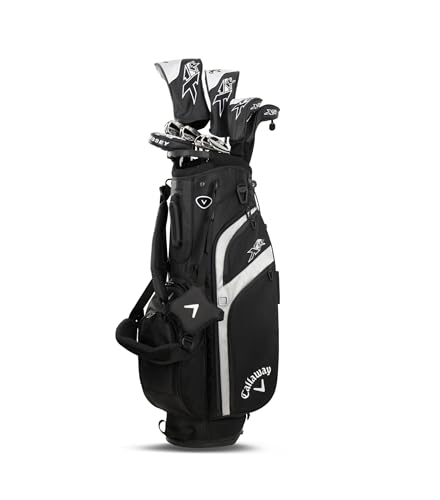
Type: Premium complete set
Make-up: 460cc titanium driver, fairway woods, hybrids, game-improvement irons, sand wedge, putter
Shafts: Graphite woods; see listing
Buyer feedback: 4.5 stars from 58 ratings
Best for: Golfers moving up from a starter set in one purchase
If you started with a boxed set such as Callaway Strata and want to upgrade everything at once, XR is the logical next step. The 460cc titanium driver has a high-speed face, the fairway woods are built to protect ball speed on off-centre hits, the hybrids replace long irons and the irons use a classic game-improvement shape. It is far closer to buying individual retail clubs than any starter set. For more on the Strata-to-XR path, see are Strata golf clubs good, and for the full range of sets, the best golf club sets.
Pros
- Upgrades the whole bag in one go
- Titanium driver and retail-style irons
- Good buyer rating
- Cohesive set make-up
Cons
- Premium price for a box set
- Less customisable than individual clubs
- Not fitted to your swing
8. TaylorMade RBZ SpeedLite 2 Complete Set – Best Major-Brand Steel Complete Set

Type: Complete set (11 pieces)
Make-up: Driver, woods, hybrid, irons, putter (11-piece listing)
Shafts: Steel iron shafts, regular (listing shown)
Buyer feedback: 4.5 stars from 27 ratings
Best for: Improving players who want steel irons in a boxed set
Most complete sets use light graphite iron shafts, which can feel flimsy once your swing speed and consistency improve. This RBZ SpeedLite 2 listing pairs TaylorMade’s complete-set woods with steel-shafted irons, giving more control and a more solid feel. It is a practical option for an intermediate golfer who wants a matched set from a major brand without assembling clubs one by one. Stock is limited, so check the configuration before buying.
Pros
- Steel iron shafts for control
- TaylorMade design
- Complete matched set
- Positive buyer feedback
Cons
- Limited stock
- Not as advanced as individual retail clubs
- Fewer clubs than a full 14
Which Should You Choose?
| Your situation | Best pick | Why |
|---|---|---|
| Solid ball-striker, 10–15 handicap | Srixon ZXi5 or TaylorMade P790 | Players-distance balance of feel and forgiveness |
| Want maximum distance from irons | Mizuno JPX925 Hot Metal | Fast face across a large area |
| Prefer a compact head | Mizuno JPX925 Hot Metal Pro | Smaller profile, same speed tech |
| Irons fly too low | Callaway Paradym Ai Smoke HL | Built for higher launch |
| Want premium on a budget | Callaway Paradym X | Previous-generation value |
| Upgrading from a starter set | Callaway XR complete set | Whole-bag upgrade in one box |
| Want steel irons in a boxed set | TaylorMade RBZ SpeedLite 2 | More control than graphite starter irons |
Intermediate Golf Club Buying Guide
Players-distance vs. game-improvement irons
Game-improvement irons have large heads, thick toplines, wide soles and plenty of offset for maximum forgiveness. Players-distance irons are more compact and often hollow or forged-faced, offering much of the forgiveness and distance in a cleaner shape. Most intermediates sit between the two: if you still miss the centre often, lean towards game improvement; if your strike is consistent, players-distance irons will reward you. Our guides to the best game improvement golf clubs and the best set of irons go deeper, and what is offset in golf clubs explains one of the key differences.
Forged vs. cast
Forged irons are prized for their soft feel, while cast irons are typically more affordable and can be more forgiving. Many modern irons combine a forged face with a cast or hollow body. Our explainer on what is a forged golf club covers the trade-offs.
Get the shafts right
As swing speed and consistency improve, the light graphite shafts in starter sets can lead to inconsistent strikes and high, spinny shots. Many intermediates move to steel iron shafts or heavier graphite. Flex should match your speed: regular for most, stiff for faster swingers, and senior flex for slower ones; see senior flex explained.
Set make-up and gapping
Plan your bag from the top down. Most intermediates carry a driver, one or two fairway woods, one or two hybrids, irons from about 5 or 6 to pitching wedge, and two or three wedges. Aim for roughly 10 to 15 yards between clubs. Our guides to what clubs are in a golf set and the best golf wedges help you fill the gaps.
Should intermediates get fitted?
Yes. This is the stage where fitting delivers the most value, because your swing is consistent enough for a fitter to match length, lie angle, shaft and head to it. A fitting can reveal that you need a different flex, an upright lie or a different head entirely. See how to get fitted for golf clubs and how much a golf club fitting costs.
Upgrading in Stages
You do not need to replace everything at once. A sensible order for most intermediates is: irons first (they hit the most approach shots), then wedges, then the driver, then fairway woods and hybrids. Many golfers keep a putter they like for years. Selling your old set offsets the cost; see where to sell golf clubs and our breakdown of how much golf clubs cost.
Final Verdict
For most intermediate golfers, the Srixon ZXi5 offers the best balance of forgiveness, feel and versatility. The TaylorMade P790 is the premium alternative for consistent strikers, and the Mizuno JPX925 Hot Metal is the pick if you want more distance. If you want to replace a starter set in one step, the Callaway XR is the most complete upgrade. Whatever you choose, get fitted if you can.
Frequently Asked Questions
What are the best golf clubs for intermediate golfers?
Players-distance irons such as the Srixon ZXi5 and TaylorMade P790 offer the best balance of forgiveness and control for most intermediates. Distance-focused options like the Mizuno JPX925 Hot Metal suit players who want more ball speed.
What handicap is an intermediate golfer?
Most people consider handicaps of roughly 10 to 20, or regular scores between about 85 and 100, to be intermediate.
Should intermediate golfers use game improvement irons?
Many do, especially those who still mishit shots regularly. Golfers with consistent strikes often benefit from slightly more compact players-distance irons.
When should I upgrade from beginner golf clubs?
Consider upgrading when you consistently break 100, when your swing speed outgrows the light shafts in your starter set, or when yardage gaps cost you shots.
Should intermediate golfers get fitted?
Yes. Once your swing is repeatable, a fitting can match length, lie, shaft and head to your swing and often has the biggest impact of any equipment change.
Are forged irons good for intermediate golfers?
Forged or forged-face irons can suit intermediates who strike the ball consistently and value feel. Many modern forged-face designs are also quite forgiving.