

Quick answer: There is no single right age, but many children can start playing with plastic golf toys at around 2 to 4, move to light, properly sized real clubs at around 4 to 6, and begin structured lessons or junior programmes at around 6 to 8. The best time to start is when a child shows interest, can follow simple instructions and can make a full swing safely. Keep it fun, keep sessions short and use clubs sized by height; see the best kids golf clubs.
Parents often ask whether their child is too young, or too old, to start golf. The good news is that golf is one of the most flexible sports: kids can begin with toy clubs as toddlers, pick up the game properly in primary school or start as teenagers and still become excellent players. What matters more than the starting age is that early experiences are positive, the equipment fits and the child enjoys it.
This guide breaks down what kids can typically do at each age, how to introduce the game, what equipment they need and how to tell when they are ready for lessons.
Golf by Age: What to Expect
| Age | Typical stage | Focus | Equipment |
|---|---|---|---|
| 2–3 | Play and exploration | Swinging, hitting a big ball, putting into a cup | Plastic toy set |
| 4–5 | First real swings | Simple grip, short swings, putting and chipping games | Very light junior set (3 clubs) |
| 6–8 | Learning fundamentals | Grip, stance, full swing, short-course holes | Junior set with hybrid or wood |
| 9–12 | Developing skills | Full rounds on short courses, basic rules, etiquette | Junior set with more clubs |
| 13+ | Playing seriously | Full courses, competition, practice routines | Teen set or lightweight adult clubs |
These stages are guides, not rules. Coordination, attention span and interest vary a great deal between children.
Ages 2–3: Golf as Play
At this age, golf is simply a game of swinging and hitting. Plastic clubs and large, soft balls are safe indoors and in the garden. The goals are coordination and fun: hitting a ball off a mat, knocking it into a cup or toward a flag. Avoid real metal clubs, which are too heavy and can be dangerous for toddlers.
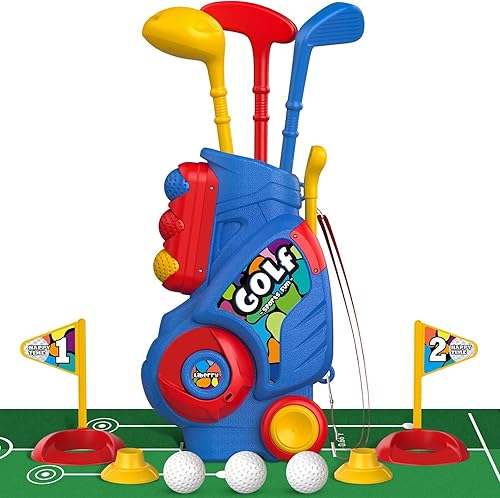
Ages: listed for 1–4
Includes: golf cart, mat, 3 plastic clubs (putter, iron, wood), 2 holes, 2 flags, tees and 6 balls
Buyer feedback: 4.7 stars from 802 ratings
A plastic toddler set like this Liberry kit is a safe first introduction. The clubs are lightweight and the set includes a mat, holes and flags, so children can play simple target games indoors or outside. The putter and iron are listed as left-handed compatible.
Ages 4–5: The First Real Clubs
Many children are ready for light, real clubs around 4 or 5, once they can make a full swing without losing their balance and can follow simple safety rules. Start with just three clubs: a driver or wood, a mid iron and a putter. Sessions should be short (15 to 30 minutes) and built around games. Size the clubs by height using our junior golf clubs size guide.

Ages / height: 3–5 (3’6″–4’1″) and 5–8 (4’1″–4’8″)
Includes (smallest size): 14° driver, 7-iron, mallet putter, bag, headcover
Buyer feedback: 4.7 stars from 119 ratings
This simple, ultra-light set is a natural step up from toy clubs. The graphite shafts are easy for small children to swing, and limiting the bag to three clubs keeps learning simple.
Ages 6–8: Learning the Fundamentals
This is the age many coaches and junior programmes begin structured instruction. Children can learn a proper grip, stance and posture, make a repeatable full swing and play short holes. Group lessons work well because they are social and game-based. A junior set with a hybrid or lofted wood makes long shots easier. Compare options in the best kids golf clubs.

Ages / height: 4–7, up to 4’6″
Includes: 15° driver, 7-iron, 9-iron, mallet putter, stand bag
Buyer feedback: 4.8 stars from 1,005 ratings
With clearly listed club lengths and a lofted, oversized driver, this highly rated set suits younger children who are starting lessons and short-course golf.
Ages 9–12: Developing Skills
By now, many kids can play full holes on short or family courses, learn basic rules and etiquette and start keeping score. They benefit from a few more clubs, including a wedge for short shots. Encourage practice that mixes long game, short game and putting. For club selection basics, see which golf club to use.
Ages 13 and Up: Never Too Late
Teenagers who start golf often progress quickly, because they are stronger, more coordinated and can focus for longer. Many good players took up the game in their teens. A teen set or lightweight adult clubs are appropriate depending on height and swing speed; see what length golf clubs do I need and the best golf clubs for beginners.
Signs Your Child Is Ready
- They show genuine interest, perhaps after watching you play.
- They can follow two- or three-step instructions.
- They can make a swing without losing balance.
- They understand basic safety, such as not swinging near others.
- They can focus on an activity for at least 15 to 20 minutes.
How to Introduce Golf to Kids
- Start on the putting green. It is easy, safe and gives quick success.
- Play games. Target challenges, putting competitions and chipping into a basket keep it fun.
- Keep sessions short and stop while they are still enjoying it.
- Use the right equipment. Light, properly sized clubs and soft balls for very young kids.
- Try short courses. Par-3 and family courses build confidence.
- Praise effort, not results.
- Bring a friend. Golf is more fun with company.
Safety First
- Teach kids never to swing when someone is nearby, and to check around them first.
- Use plastic clubs and soft balls indoors.
- Supervise young children with real clubs at all times.
- Use sun protection, water and hats on the course.
Equipment by Age
| Age | Clubs | Balls | Other |
|---|---|---|---|
| 2–3 | Plastic toy set | Large soft balls | Indoor mat, toy flags |
| 4–5 | Driver or wood, 7-iron, putter | Soft or junior balls | Light carry bag |
| 6–8 | Add a hybrid and 9-iron or wedge | Junior or low-compression balls | Stand bag, glove |
| 9–12 | Add more irons and a wedge | Low-compression balls | Golf shoes, rangefinder optional |
| 13+ | Teen or adult set | Standard balls | Full equipment |
Choose clubs by height, not age, and avoid cutting down adult clubs; they stay heavy and stiff. Our best kids golf clubs guide compares sets for every stage, and you can check the length of existing clubs with how to measure golf club length.
Lessons and Junior Programmes
Many golf clubs and ranges run junior academies and group classes, often from around age 5 or 6. Group sessions are typically game-based and inexpensive compared with private lessons. Private lessons become more valuable once a child is committed and wants to improve specific skills. Look for coaches who have experience teaching children and who keep sessions active.
Benefits of Starting Golf Young
- Coordination and motor skills from swinging and hitting a small target.
- Focus and patience, because golf rewards concentration.
- Honesty and etiquette, since players keep their own score and respect others.
- Time outdoors and walking.
- A lifelong sport that can be shared across generations.
Common Mistakes Parents Make
- Too much technical instruction too soon. Young kids learn best through play.
- Sessions that are too long.
- Ill-fitting or heavy clubs.
- Starting on a full-length course instead of a short course or putting green.
- Pushing competition before the child is ready.
How Much Does It Cost to Start a Child in Golf?
Starting costs can be modest. A plastic toy set is a low-cost tier purchase, and many junior sets sit in the budget-to-mid price tier. Short-course green fees and group lessons for juniors are often discounted. Because kids outgrow clubs every few years, many families buy mid-tier sets and hand them down or sell them; see where to sell golf clubs. For adult cost context, see how much golf clubs cost.
Should Kids Play Other Sports Too?
Yes. Many coaches encourage young children to play a variety of sports, which builds overall athleticism, coordination and enjoyment and reduces the risk of burnout. Skills from sports such as tennis, baseball and football often transfer well to golf. Specialising early is rarely necessary for golf, where players often peak in their twenties and thirties.
Fun Golf Games for Kids
- Putting ladder: putt to targets at increasing distances; move up a rung with each success.
- Chip into a bucket: score points for landing in or near a laundry basket.
- Target practice: hit soft balls at hoops or towels on the lawn.
- Around the clock: putt from positions around a hole like the numbers on a clock.
- Family mini-round: a few short holes with simple scoring and prizes.
A Sample First Session Plan (Ages 4–7)
| Time | Activity | Goal |
|---|---|---|
| 5 minutes | Safety talk and warm-up games | Know where to stand and when to swing |
| 5 minutes | Putting to a hole or cup | Early success and confidence |
| 5 minutes | Chipping into a basket or hoop | Learn a short, controlled swing |
| 5–10 minutes | Hitting soft balls with a wood or 7-iron | Experience a full swing |
| 5 minutes | Fun putting competition | Finish on a high note |
Keep the plan flexible. If the child loves putting, let them putt longer; if they lose interest, end early. The aim of the first few sessions is simply to make them want to come back.
Golf for Girls and Boys
Girls and boys can start at the same ages and use the same junior sizing, which is based on height. Girls-only junior programmes and matching colourful sets can help some young players feel more comfortable. The most important factors are the same for everyone: fitting equipment, a supportive environment and fun.
What If My Child Loses Interest?
It is normal for interest to come and go. Take a break, try a different format such as mini golf, a driving range with targets or a family short course, and let the child lead. Avoid turning practice into a chore with strict schedules or targets. Many golfers return to the game later with a stronger desire to play, especially if their early memories of golf were positive.
Bottom Line
Kids can start golf as toddlers with plastic clubs, move to light real clubs around 4 to 6 and begin lessons around 6 to 8, but the best age is whenever a child is interested and ready. Keep it fun, keep sessions short and make sure the clubs fit. When your child is ready for real clubs, compare our picks for the best kids golf clubs.
Frequently Asked Questions
What age should kids start golf?
Many children start with plastic clubs at 2 to 4, light real clubs at 4 to 6 and lessons at 6 to 8. The best age is when a child is interested and can swing safely.
Can a 3-year-old play golf?
Yes, as play. A 3-year-old can swing plastic or very light clubs and enjoy putting and hitting games, with close supervision.
When should kids start golf lessons?
Group lessons often begin around 5 to 8. Private lessons become more useful once a child is committed and wants to improve.
Is 13 too old to start golf?
No. Teenagers often progress quickly because of their strength and focus, and many good golfers started in their teens.
What golf clubs should a young child use?
Light, junior-specific clubs sized by height, starting with just a driver or wood, a mid iron and a putter.
How long should a kids golf session be?
For young children, about 15 to 30 minutes is plenty. Stop while they are still having fun.